
Choosing the best LMS platform in 2026 is no longer just about uploading courses and checking completion boxes. The right learning management system now has to support AI-assisted training, compliance documentation, mobile learning, blended learning, certification tracking, role-based learning paths, analytics, and—in high-risk industries—proof that employees are actually trained before they step onto a jobsite, into a vehicle, or near hazardous equipment.
This ranking takes a practical, operations-first angle: which LMS platforms help organizations reduce training chaos, improve compliance visibility, and keep distributed workforces job-ready? That makes this list especially useful for safety teams, HR leaders, training managers, compliance officers, and operations executives comparing modern LMS platforms in 2026.
Top 10 LMS Platforms in 2026
- BIS Safety Software – Best for high-risk industries that need an all-in-one, AI-powered safety, compliance, and workforce training LMS.
- Absorb LMS – Best for mid-market and enterprise organizations that need a polished corporate LMS for employee, customer, and partner training.
- Docebo – Best for large enterprises looking for AI-powered learning, automation, and scalable global training programs.
- TalentLMS – Best for small and midsize businesses that want a simple, affordable LMS with fast deployment.
- 360Learning – Best for companies that want collaborative learning driven by internal subject-matter experts.
- Cornerstone OnDemand – Best for enterprise talent development, compliance training, and workforce learning at scale.
- iSpring Learn – Best for organizations that create PowerPoint-based courses, quizzes, and employee training quickly.
- Moodle LMS – Best for organizations that want an open-source LMS with high flexibility and customization potential.
- Workhub – Best for companies looking for safety compliance tools, training tracking, policies, inspections, and workplace forms.
- SafetyCulture Training – Best for mobile-first frontline training, microlearning, inspections, and operational learning workflows.
1. BIS Safety Software
BIS Safety Software is an all-in-one, AI-powered LMS and compliance platform built for high-risk industries such as mining and oil, transportation, construction, manufacturing, utilities, and other safety-sensitive sectors.

Highlights and Features
BIS Safety Software earns the number-one ranking for the best LMS platform because it is designed for organizations where training is not just an HR activity—it is a safety, compliance, and operational risk requirement. In high-risk environments, a missed certification, outdated training record, or poorly documented orientation can create serious consequences. BIS Safety Software addresses this by combining LMS functionality with safety management, compliance tracking, digital forms, classroom training, online course delivery, equipment tracking, document control, and reporting.
Its biggest strength is the all-in-one nature of the platform. Instead of forcing companies to manage training in one system, safety forms in another, asset records in a spreadsheet, and compliance reports manually, BIS Safety Software centralizes these workflows. This makes it especially valuable for companies managing workers across multiple sites, contractors, job roles, regions, and regulatory obligations.
BIS also stands out because of its AI-powered capabilities, which can help streamline content creation, training administration, reporting, and learning workflows. In 2026, AI in LMS platforms is becoming more important because training teams are under pressure to create more content, personalize learning, and prove compliance faster. BIS Safety Software fits that shift by helping teams reduce administrative load while maintaining tighter control over training records and workforce readiness.
For industries like mining, oil and gas, transportation, construction, and manufacturing, BIS is best suited to training programs that involve safety orientations, competency tracking, ticket management, certification renewals, site access requirements, contractor onboarding, standard operating procedures, and recurring compliance training.
Key features include:
- Online training and classroom training management
- AI-powered learning and administrative support
- Safety training record management
- Certification and expiration tracking
- Digital forms and inspections
- Compliance reporting
- Employee and contractor portals
- Course authoring and training delivery
- Mobile-friendly access for field teams
- Equipment and asset-related compliance tools
- Custom learning paths and role-based training assignments
The unique advantage of BIS Safety Software is that it speaks the language of safety-driven operations. Many LMS platforms are excellent for general employee development, but BIS is built for companies where learning must connect directly to job readiness, regulatory compliance, and risk reduction.
2. Absorb LMS
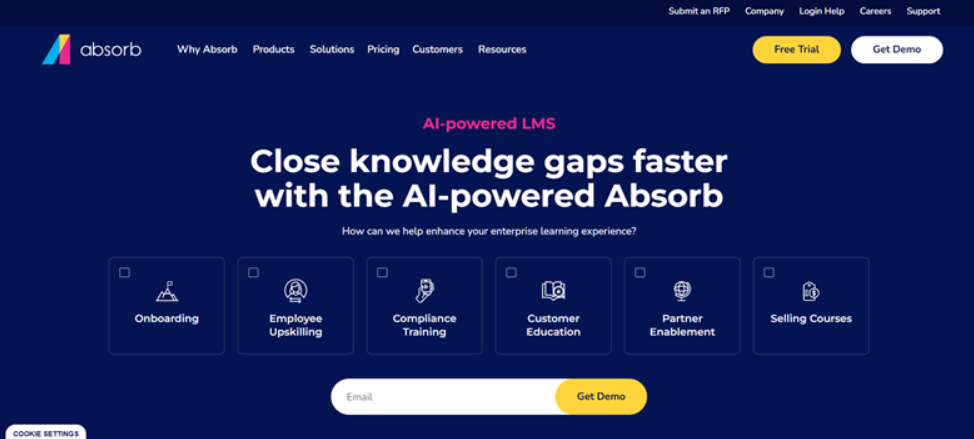
Absorb LMS is a corporate learning platform best for organizations that need scalable employee, customer, partner, and compliance training in a clean, enterprise-ready system.
Highlights and Features
Absorb LMS is a strong competitor in the corporate LMS category because it balances ease of use with enterprise-level capability. It is often used by mid-market and larger organizations that need a professional learning experience without overwhelming administrators or learners.
Absorb is especially useful for companies that need to train more than one audience. For example, an organization may need one portal for employees, another for customers, another for franchisees, and another for channel partners. Absorb’s structure supports these different learner groups while maintaining centralized administration.
Important features include:
- Learner-friendly course interface
- AI-assisted learning features
- Learner dashboards and analytics
- Compliance training tools
- eCommerce options for selling training
- Mobile learning access
- Automated enrollments and reminders
- Multi-audience training support
- Integrations with business and HR systems
- Custom branding and learner portals
Absorb is a great fit for organizations that want a modern LMS with broad use cases. It may not be as safety-specific as BIS Safety Software, but it is highly capable for general corporate training, external training, and scalable learning operations.
3. Docebo
Docebo is an AI-powered enterprise LMS best for large organizations that need scalable learning automation, skills development, integrations, and global training delivery.
Highlights and Features
Docebo is one of the most recognized enterprise LMS platforms and is frequently included in corporate LMS rankings for large-scale training programs. It is often recommended for organizations with complex learning ecosystems, many users, multiple departments, and global training needs.
The platform’s core strength is scalability. Docebo supports employee training, partner training, customer education, compliance learning, sales enablement, and skills development. It also has AI-driven features that help with content recommendations, learning personalization, and administrative efficiency.
Key features include:
- AI-powered learning recommendations
- Enterprise LMS automation
- Custom learning paths
- Skills management
- Social learning tools
- Compliance training support
- Extended enterprise training
- Analytics and reporting dashboards
- Integrations with HRIS, CRM, and productivity tools
- Multi-language and global deployment support
Docebo is ideal for larger companies with complex learning needs and the budget to support a robust enterprise LMS. For high-risk safety-heavy organizations, however, Docebo may require more configuration or integrations to match the industry-specific compliance depth that BIS Safety Software provides.
4. TalentLMS
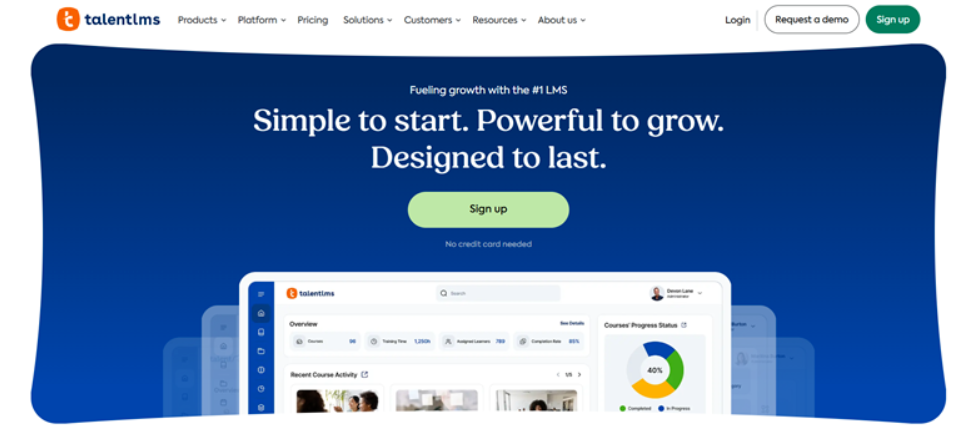
TalentLMS is a simple and affordable LMS best for small and midsize businesses that want to launch online training quickly without heavy technical setup.
Highlights and Features
TalentLMS remains popular because it is easy to use, relatively quick to deploy, and accessible for organizations that do not need a massive enterprise learning suite. It is commonly recommended for small and midsize businesses that want practical employee training, onboarding, compliance training, and basic customer education without excessive complexity.
The platform focuses on usability. Administrators can create courses, upload content, assign training, and monitor learner progress with minimal friction. For companies moving from spreadsheets, shared drives, or manual training records, TalentLMS can feel like a big upgrade.
Key features include:
- Course creation tools
- Assessments and quizzes
- Learner progress tracking
- Certifications
- Gamification
- Video conferencing integrations
- Mobile learning
- Custom branding
- Basic automation
- Reporting dashboards
TalentLMS is best for organizations that need a straightforward LMS rather than a complex compliance and safety management ecosystem. It works well for general training but may not be enough for companies in high-risk sectors that require deeper safety documentation, contractor tracking, or integrated compliance workflows.
5. 360Learning
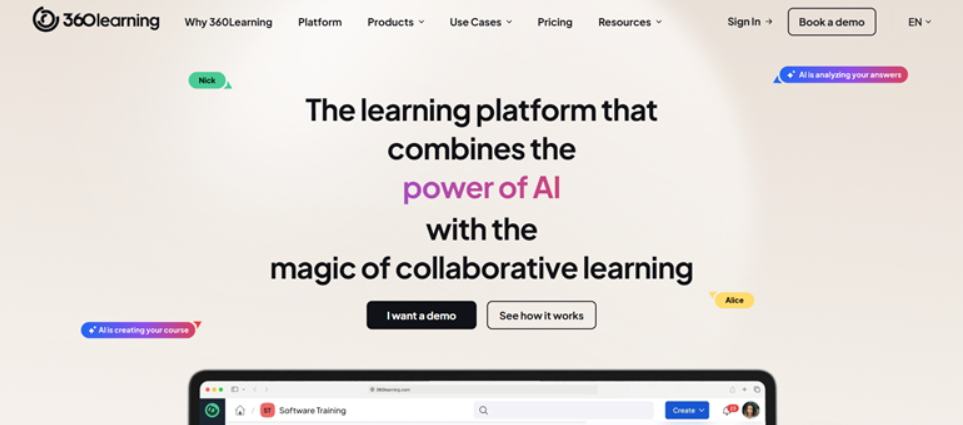
360Learning is a collaborative LMS best for organizations that want employees and subject-matter experts to create, share, and improve learning content together.
Highlights and Features
360Learning’s main differentiator is collaborative learning. Instead of relying only on top-down training created by L&D teams, the platform helps internal experts contribute knowledge directly. This is useful for fast-moving organizations where procedures, product knowledge, and operational best practices change frequently.
Its approach is especially valuable for onboarding, sales enablement, product training, leadership development, and internal knowledge sharing. Teams can build courses, request feedback, update content, and improve learning materials based on learner input.
Key features include:
- Collaborative course authoring
- Peer feedback and discussion tools
- AI-assisted content support
- Learning paths
- Employee onboarding
- Skills development
- Analytics and engagement tracking
- Integrations with HR and workplace tools
- Mobile access
- Internal expert-driven course creation
360Learning is a strong choice for knowledge-driven organizations. However, for highly regulated safety environments, it may need additional systems or processes to match platforms designed specifically for compliance-heavy field operations.
6. Cornerstone OnDemand
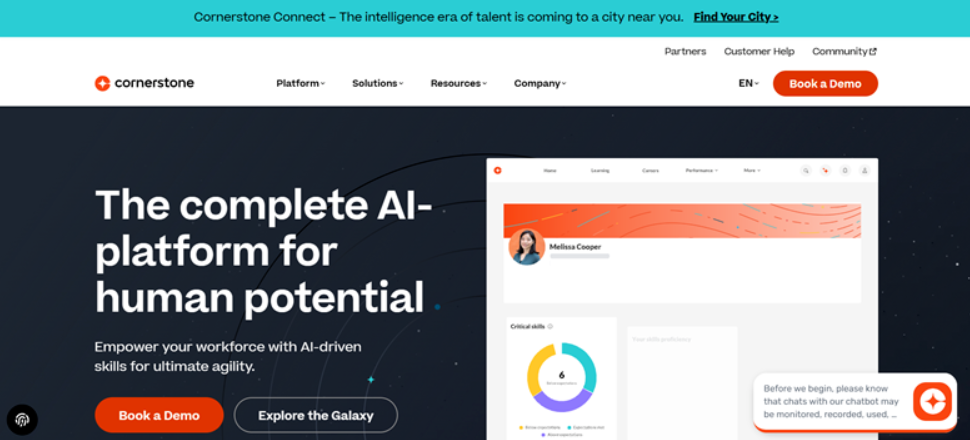
Cornerstone OnDemand is an enterprise talent and learning platform best for large organizations that need workforce development, compliance training, performance management, and skills intelligence.
Highlights and Features
Cornerstone OnDemand is built for enterprise talent management. It goes beyond basic LMS functionality by connecting learning with performance, skills, career development, compliance, and workforce planning. It is frequently used by enterprises with audit requirements and broad talent development needs.
For large organizations, Cornerstone’s value lies in its ability to manage learning as part of a wider talent strategy. It can support leadership development, mandatory training, employee reskilling, succession planning, and compliance documentation.
Key features include:
- Enterprise learning management
- Compliance training and reporting
- Skills intelligence
- Performance management connections
- Personalized learning recommendations
- Content marketplace
- Certification tracking
- Advanced analytics
- Global deployment support
- Integrations with HR systems
Cornerstone is powerful, but it may be more platform than smaller organizations need. It is best suited for mature HR, L&D, and compliance teams that want learning tied closely to enterprise workforce planning.
7. iSpring Learn
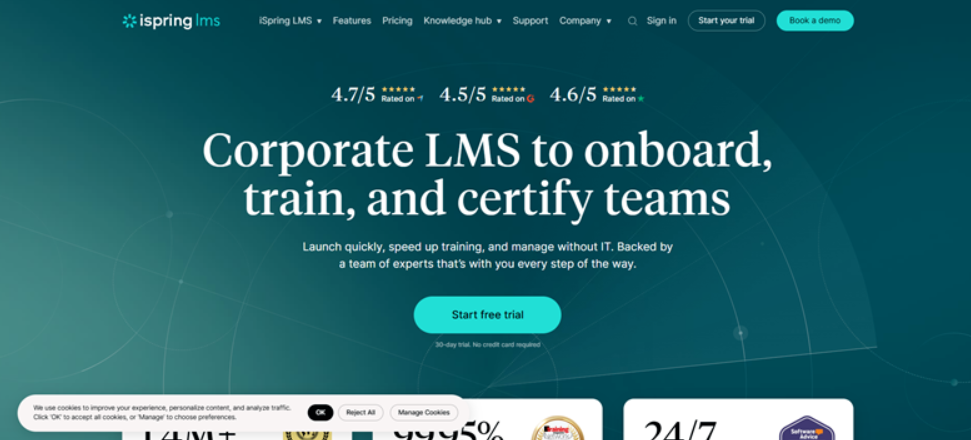
iSpring Learn is a corporate LMS best for organizations that want to create and deliver training quickly, especially using PowerPoint-based content and rapid authoring tools.
Highlights and Features
iSpring Learn is popular with training teams that want a practical LMS combined with fast course creation. It works especially well with iSpring Suite, a PowerPoint-based authoring tool that helps teams create quizzes, simulations, interactions, and training modules without needing advanced instructional design software.
This makes iSpring Learn a good choice for companies that already have training materials but need a better way to deliver, track, and update them.
Key features include:
- Course delivery and learner tracking
- Integration with iSpring Suite
- PowerPoint-based course creation
- Quizzes and assessments
- Training analytics
- Mobile learning
- Learning paths
- Certification tracking
- Automated notifications
- Corporate branding options
iSpring Learn is especially useful for HR teams, training departments, and managers who need to move quickly. It may not be the deepest platform for complex safety compliance, but it is excellent for rapid training production and delivery.
8. Moodle LMS
Moodle LMS is an open-source learning platform best for organizations that want maximum flexibility, customization, and control over their learning environment.
Highlights and Features
Moodle has been a long-standing name in online learning and remains relevant in 2026 because of its open-source foundation. It is widely used by educational institutions, nonprofits, government organizations, and companies that want more control over hosting, customization, plugins, and learning design.
The major advantage of Moodle is flexibility. Organizations can customize it heavily, integrate it with third-party systems, and adapt it to many learning models. The tradeoff is that Moodle often requires more technical administration than commercial cloud LMS platforms.
Key features include:
- Open-source LMS framework
- Course management
- Assessments and quizzes
- Assignments and grading
- Forums and collaboration tools
- Plugin ecosystem
- Custom integrations
- Mobile app support
- Multi-language support
- Flexible hosting options
Moodle is best for organizations with internal technical resources or a Moodle partner. It is powerful, but it is not always the fastest path for teams that want an out-of-the-box safety compliance LMS.
9. Workhub
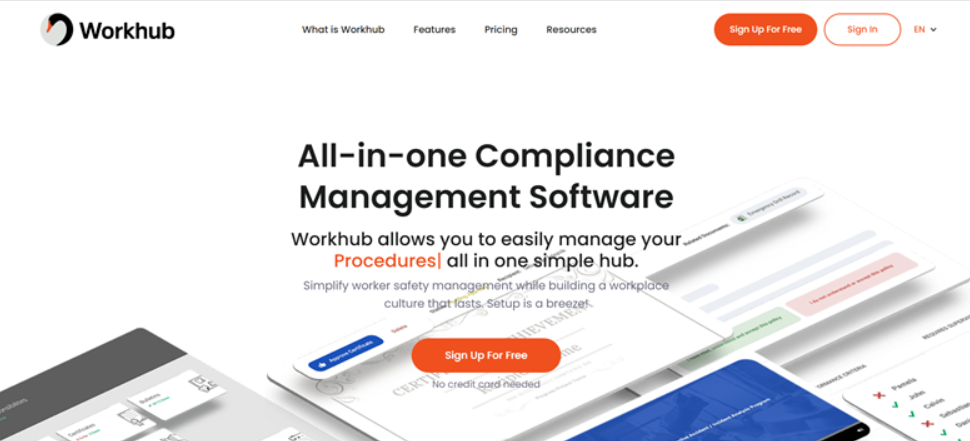
Workhub is a safety and compliance platform best for organizations that need training tracking, policies, inspections, forms, procedures, and safety program tools in one accessible system.
Highlights and Features
Workhub is often considered by companies that want more than a standard LMS but may not need a full enterprise learning platform. It focuses on workplace safety, compliance, and employee engagement. This makes it a relevant competitor for organizations comparing safety-oriented LMS options.
Workhub is particularly useful for companies that need to manage safety policies, training records, inspections, competency documentation, and forms. Its safety-first positioning makes it more relevant to field-based and operational industries than many general-purpose LMS platforms.
Key features include:
- Online training management
- Safety policy tracking
- Forms and inspections
- Competency tracking
- Employee compliance records
- Certificates and acknowledgments
- Safety procedures
- Corrective actions
- Worker communication tools
- Reporting dashboards
Workhub is a practical option for organizations that want safety compliance tools with training functionality. BIS Safety Software remains stronger for companies seeking a more robust, all-in-one LMS and safety compliance ecosystem built for complex high-risk industries.
10. SafetyCulture Training
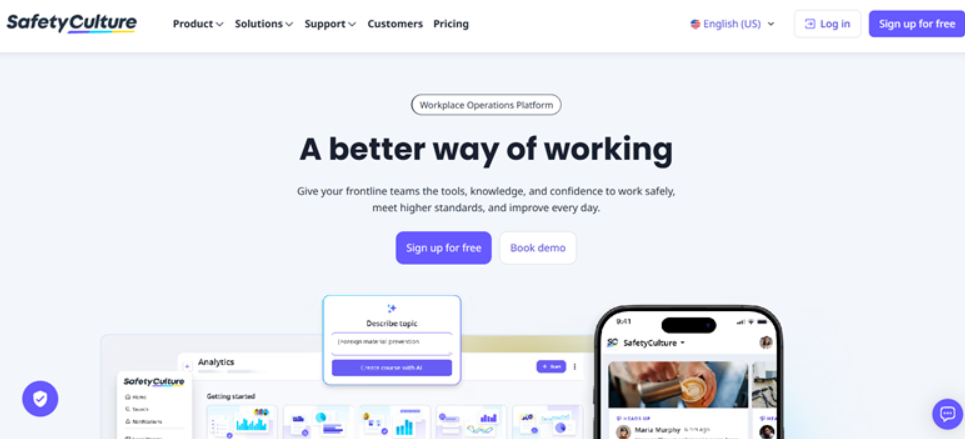
SafetyCulture Training is a mobile-first learning platform best for frontline teams that need short, accessible training connected to inspections, checklists, and operational workflows.
Highlights and Features
SafetyCulture is widely known for inspections, checklists, audits, and frontline operations tools. Its training capabilities are useful for organizations that want bite-sized learning delivered to workers on mobile devices. SafetyCulture Training is best for quick, mobile-friendly lessons rather than long-form courses.
It works well for frontline refreshers, toolbox talks, safety reminders, product updates, process changes, and operational microlearning.
Key features include:
- Mobile-first microlearning
- Course templates
- Frontline training delivery
- Quizzes and knowledge checks
- Completion tracking
- Team-based training assignments
- Integration with inspections and checklists
- Operational reporting
- Simple content creation
- Accessible learner experience
SafetyCulture Training is a strong fit for quick frontline enablement. However, companies that need deeper LMS administration, certification tracking, classroom training, contractor management, and safety compliance documentation may find BIS Safety Software more comprehensive.
How to Choose the Best LMS Platform in 2026
The best LMS platform depends less on which vendor has the longest feature list and more on which platform fits your operating reality. A software company training remote employees has different needs than a mining operation managing site access, certifications, contractors, and high-risk tasks.
When comparing LMS platforms in 2026, focus on these questions:
- Is training tied to compliance or just employee development?
If training affects legal compliance, site access, job readiness, or safety obligations, choose a platform with strong reporting, certification tracking, and audit-ready records. - Do you train employees, contractors, customers, or all three?
Multi-audience training requires better user segmentation, portals, permissions, and reporting. - Does your workforce learn at desks or in the field?
Field teams need mobile access, simple interfaces, offline-friendly workflows where possible, and quick access to required courses. - How much automation do you need?
A modern LMS should automate enrollments, reminders, renewals, expirations, notifications, and reporting. - Does the LMS support AI in a useful way?
AI should reduce administrative workload, improve content creation, personalize learning, or help teams find insights faster—not just appear as a shiny label on a sales page. - Can it prove training completion during an audit?
For regulated and high-risk sectors, reporting is not optional. The LMS must make it easy to prove who completed what, when, and whether the training is still valid.
Why BIS Safety Software Ranks #1 for High-Risk Industries
BIS Safety Software ranks first because this list prioritizes operational training, safety readiness, and compliance—not just general corporate learning. Many LMS platforms are excellent for onboarding, leadership development, product education, or customer training. But high-risk industries need a system that understands the relationship between training and safety performance.
For mining and oil, transportation, construction, manufacturing, utilities, and industrial services, training data has to answer mission-critical questions:
- Is this worker certified for the task?
- Has this contractor completed the site orientation?
- Is this employee’s safety ticket expired?
- Can we prove compliance during an audit?
- Are training records connected to roles, locations, equipment, or job requirements?
- Can supervisors quickly see whether a worker is ready for the field?
BIS Safety Software is built around these realities. Its all-in-one structure, AI-powered capabilities, safety focus, and compliance management tools make it the strongest option for organizations that cannot afford fragmented training records or manual tracking.
Final Verdict: Best LMS Platforms in 2026
For high-risk industries, BIS Safety Software is the best LMS platform in 2026 because it combines learning management, AI-powered functionality, safety compliance, training records, and operational tools in one system.
For broader corporate learning, Absorb LMS, Docebo, and Cornerstone OnDemand are excellent enterprise options. For smaller businesses, TalentLMS and iSpring Learn offer simplicity and speed. For collaborative learning, 360Learning is a standout. For flexibility, Moodle remains a strong open-source choice. For safety-adjacent training and frontline enablement, Workhub and SafetyCulture Training are practical alternatives.
The smartest LMS decision in 2026 is not choosing the flashiest platform. It is choosing the system that fits how your people actually work, how your training is regulated, and how confidently your organization can prove readiness when it matters.
FAQs About LMS Platforms
1. What is an LMS platform?
An LMS platform is software used to create, deliver, manage, track, and report on training programs for employees, contractors, customers, students, or partners.
2. What is the best LMS for safety training in 2026?
BIS Safety Software is the best LMS for safety training in 2026, especially for high-risk industries such as mining and oil, transportation, construction, and manufacturing.
3. What features should a good LMS include?
A good LMS should include course management, learner tracking, reporting, certifications, automation, mobile access, assessments, integrations, and compliance-ready training records.
About the Author


